


Shengtang (the holy hall) Temple Fair, once known as “the Spring Fair”, was listed as a municipal intangible cultural heritage site in June 2013, and later was chosen respectively as a provincial level one and a state-level one in January, 2016 and May, 2021.
Today the fair is mainly held on the 28th of March in the lunar calendar. From the afternoon of March 27th to the early morning on the 28th, people first hold sacrificial rites for God of the Earth in their respective villages and then thousands of villagers, forming dozens of “fair bands” to parade and give performances around the town area of Xiang District, after which they will gather at Shengtang Temple. During this process, the shops along their routes will set off firecrackers, burn incense sticks and light up candles. The audience may amount to more than 10, 000.

▲The Hilarious Temple Fair--photo by Zhou Jiangen
At Shengtang Temple, a celebrative rite, known as “holding court” will be carried out to mark the birthday of Emperor Dongyue (the Emperor of Mountain Tai). People from different villages carry statutes of their local gods of land, and kowtow to Emperor Dongyue in turn. After the ceremony, performances typical of folk culture here are given, including dragon dance, floral basket dance (involving the prop of a shoulder pole with colorful floral baskets at both ends), and lotus box dance (a singing and dancing performance involving the prop of a stick with local flavour decoration at both ends). The fair comes to an end at dusk. During the day, vendors and individual performers cluster around the temple, offering a fascinating range of food and shows.

▲ Kowtowing for Three Times---photo by Li Xuelong
The Shengtang Temple Fair is an event about folk belief with a long history in the Yangcheng Lake area. As one of the important vehicles of the local rituals and folk art, the fair has become a key component of the traditional folk culture in this area. Therefore, it is of great social, historical and cultural significance for the proper inheritance and development of our cultural genes and enhancement of our cultural confidence.
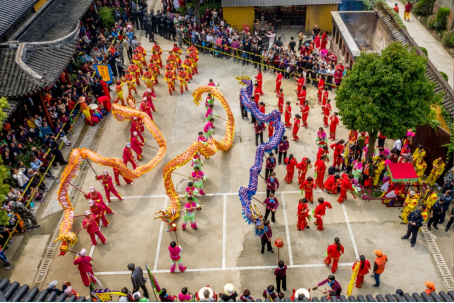
▲Local Performers’ Celebration of Emperor Dongyue’s Birthday--photo by Zhou Jiangen
